
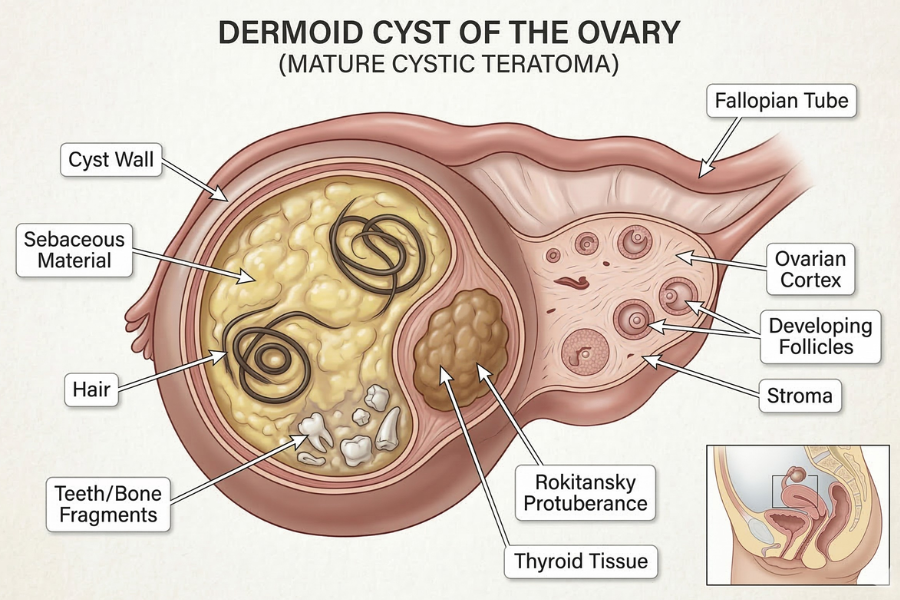
Over the years in my gynecologic practice, I have treated many women who were surprised to learn they had a cyst in their ovary that contained hair, fatty tissue, and even teeth. We call this type of cyst a dermoid cyst. Often, the diagnosis comes unexpectedly during an ultrasound ordered for pelvic pain, irregular bleeding, or sometimes even during routine imaging for something unrelated. The word “tumor” or “cyst” can understandably cause anxiety, but dermoid cysts are actually one of the most common benign ovarian tumors I see in women of reproductive age.
Dermoid cysts, medically called mature cystic teratomas, develop from germ cells in the ovary. They are formed from primitive cells that have the potential to develop into many different types of tissue in the body. These cells have not become specialized yet, like a skin or brain cell. Because of this origin, dermoid cysts can contain a mixture of tissues such as fat, hair, skin, and occasionally even teeth or bone. These cysts are typically benign and slow-growing.
Many dermoid cysts cause no symptoms at all. In fact, I frequently diagnose them incidentally when imaging is performed for another reason. When symptoms do occur, they are usually related to the size of the cyst or the pressure it places on surrounding structures. Some women describe a dull pelvic ache, a sense of fullness, or intermittent discomfort on one side of the pelvis. Others may notice pain with certain movements, physical activity, or with intercourse.
One of the main reasons we pay attention to dermoid cysts is the risk of ovarian torsion. Because these cysts can become relatively heavy, they can cause the ovary to twist around its base and blood supply. When that happens, patients typically experience sudden and severe pelvic pain, often accompanied by nausea or vomiting. Ovarian torsion is considered a surgical emergency because prolonged loss of blood flow can damage the ovary.
RELATED: Types Of Ovarian Cysts
Diagnosis usually begins with a pelvic ultrasound. Dermoid cysts often have a distinctive appearance on ultrasound because of their fat content and mixed tissue components. Radiologists frequently recognize these patterns immediately. In situations where imaging is unclear, an MRI can provide additional detail and help confirm the diagnosis before deciding on treatment.
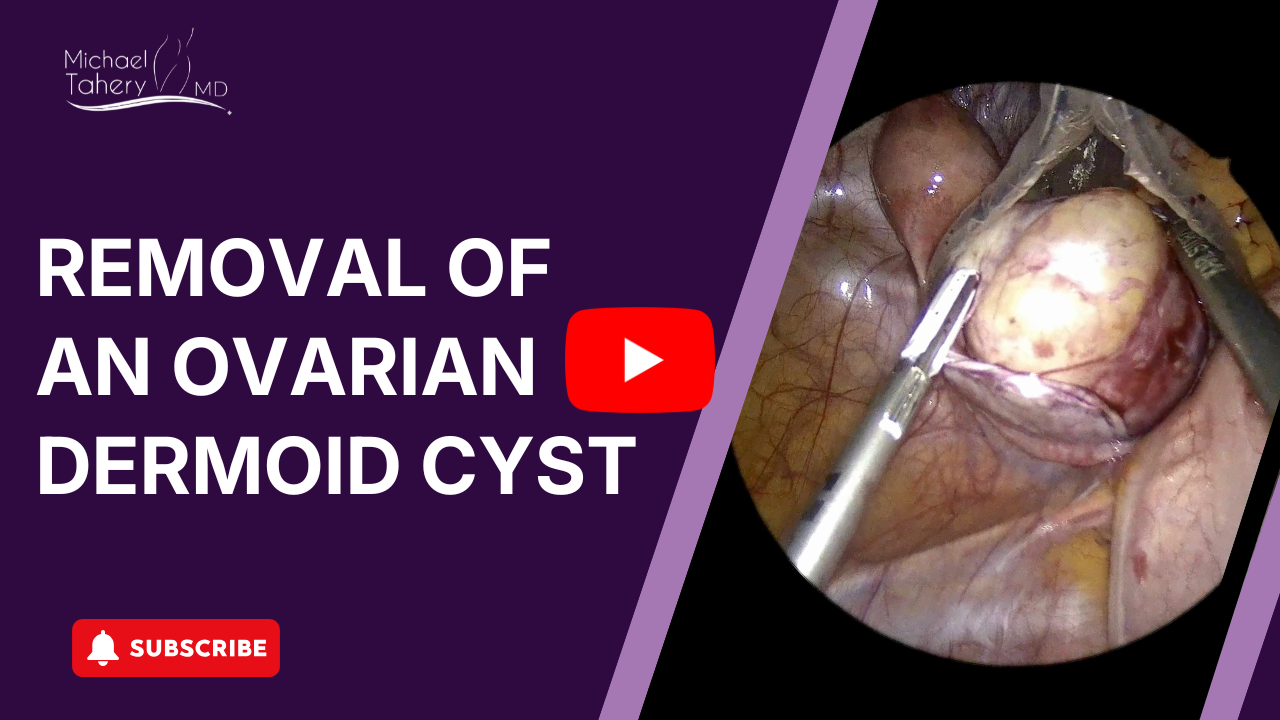
Management depends on several factors, including the size of the cyst, the presence of symptoms, the patient’s age, and fertility considerations. Small dermoid cysts that are not causing symptoms can sometimes be monitored with periodic imaging. However, once a cyst grows beyond a certain size, the risk of complications such as torsion increases, and surgical removal may be recommended.
When surgery is necessary, the goal is usually to remove the cyst while preserving as much normal ovarian tissue as possible. This procedure is called an ovarian cystectomy. In many patients, it can be performed laparoscopically using minimally invasive techniques. Through small incisions, the cyst is carefully separated from the ovary and removed while maintaining the remaining healthy ovarian tissue. Preserving ovarian function is particularly important in younger women who may wish to have children in the future.
Occasionally, if the cyst is very large or if the ovary has been extensively damaged, removal of the ovary may be necessary. Fortunately, this situation is relatively uncommon. In most cases, we are able to successfully remove the dermoid cyst while leaving the ovary intact and preserving fertility.
Recovery after minimally invasive surgery is generally smooth. Most patients return home the same day and resume normal activities within one to two weeks. After surgery, the cyst is examined by a pathologist to confirm the diagnosis.
Patients often ask whether dermoid cysts can recur. Once a dermoid cyst has been removed from an ovary, that specific cyst does not return. However, because these cysts arise from germ cells, it is possible for a new dermoid cyst to develop later in either ovary, although this does not happen frequently. There is a 15% chance of recurrence is reported.
The most important point is that dermoid cysts are common, usually benign, and highly treatable. With proper diagnosis and appropriate management, most women recover fully and continue to have normal ovarian function.
In my practice, I encourage women not to ignore persistent pelvic pain, pressure, or unexplained symptoms. Early evaluation allows us to identify ovarian conditions such as dermoid cysts before complications develop.
If you have been diagnosed with an ovarian cyst or are experiencing persistent pelvic symptoms, we can help determine whether monitoring or treatment is the appropriate next step. Book a consultation today or give us a call (818) 265-9499.